![View of the exhibition "Ieratico/Eretico" [Hieratic/Heretical] by Saturno Buttò. Photo by the PhotoPhore](https://www.thephotophore.com/wp-content/uploads/2018/10/saturno-butto-ieratico-eretico-002.jpg)
“Eretico / Ieratico” [Heretical / Hieratic] is the new exhibition by Saturno Buttò, curated by Adolfina de Stefani and Luciana Zabarella. The exhibition, organized by “Visioni Altre”, started on October 6th and will last until October 21st.
The location of the exhibition is the Oratory of Santa Maria Assunta in Spinea (near Venice), a deconsecrated church dedicated to hosting exhibitions and cultural activities. It is absolutely perfect as location and, for the possible, it could be considered as an integral part of the exhibition.
We from the PhotoPhore were there and we are happy to tell you about it!
![View of the exhibition "Ieratico/Eretico" [Hieratic/Heretical] by Saturno Buttò. Photo by the PhotoPhore](https://www.thephotophore.com/wp-content/uploads/2018/10/saturno-butto-ieratico-eretico-003.jpg)
– Saturno Buttò: “Eretico/Ieratico” – The double theme
The whole meaning of the exhibition lies precisely in the dichotomy between the two terms wisely chosen as title: “Hieratic” and “Heretical“.
HIERATIC, from the Greek ἱερός, that means “sacred, holy“: marked by a heavy and solemn sense of sacrality or devotion; to a solemn priestly composure.
HERETIC, from the Greek αἱρετικός, that means “who chooses“: who, in politics, religion or other, in the way of thinking and judging, diverges from the common opinions or those accepted by the group to which it belongs.
Here’s how in two opposing words, we can describe the Art Practice of Saturn Buttò. Many of the key themes of his art can be found in the “semantic areas” of these two “keywords“.
![The Oratory of Santa, venue of the exhibition "Ieratico/Eretico" [Hieratic/Heretical] by Saturno Buttò. Photo by the PhotoPhore](https://www.thephotophore.com/wp-content/uploads/2018/10/saturno-butto-ieratico-eretico-001.jpg)
– Saturno Buttò: “Eretico/Ieratico” – The “Hieratic” theme
With the term “hieratic“, we refer to the religious sphere. In particular to the Christian and Catholic religion.
From this “hieratic” and “religious” fields, Saturno Buttò distills 3 fundamental aspects:
1. The centrality of the Human figure.
All the Christian Holy Art created in history is based on the presence of the figure of Man.
The same God of Christians is represented as a Human Being. Just like Jesus, the Saints or the Virgin Mary. As well as the Angels, saviors of Man. And so also the Demons, tempters that lead to damnation.
![Saturno Buttò, La conversazione [The Conversation], Oil on wood, 120x120 cm [Detail] Photo by the PhotoPhore. Image courtesy of Saturno Buttò](https://www.thephotophore.com/wp-content/uploads/2018/10/saturno-butto-ieratico-eretico-005.jpg)
Photo by the PhotoPhore. Image courtesy of Saturno Buttò
2. The gestures of the characters.
There is a wide “code” that contains all the “positions“ of the characters in the paintings of Holy Art.
These rules are not absolute, of course. But they are the “gestures” that often occur in the visual representation of the characters, and which have ended up characterizing them on an iconographic level in a very focused way.
Saturno Buttò resumes these classic “poses” and “gestures“, like hands clasped in prayer, people kneeling in penance and so on, and he re-elaborates these gestures by inserting them into his paintings.
3. The third fundamental aspect derived from the Holy Art is the pictorial technique.
The paintings by Saturno Buttò are real “old-fashioned Works of Art“.
No collage, no computer reworking, no photography… The works are done in the same way that the great Italian and European masters of the Gothic, Renaissance and Baroque periods could have done: Oil on wood. Not canvases, but wooden planks, as in the early days of Western Painting.
With a precision, a wealth of details and a care for every single detail of which any “true artist” from 4-5-6 centuries ago could have been proud.
Nothing less than Rogier van der Weyden, Jan van Eyck, Leonardo da Vinci or Caravaggio.
We are not talking about the work of art itself, which can please, as in my case, or not. We are talking about the technique. An absolutely masterful technique.
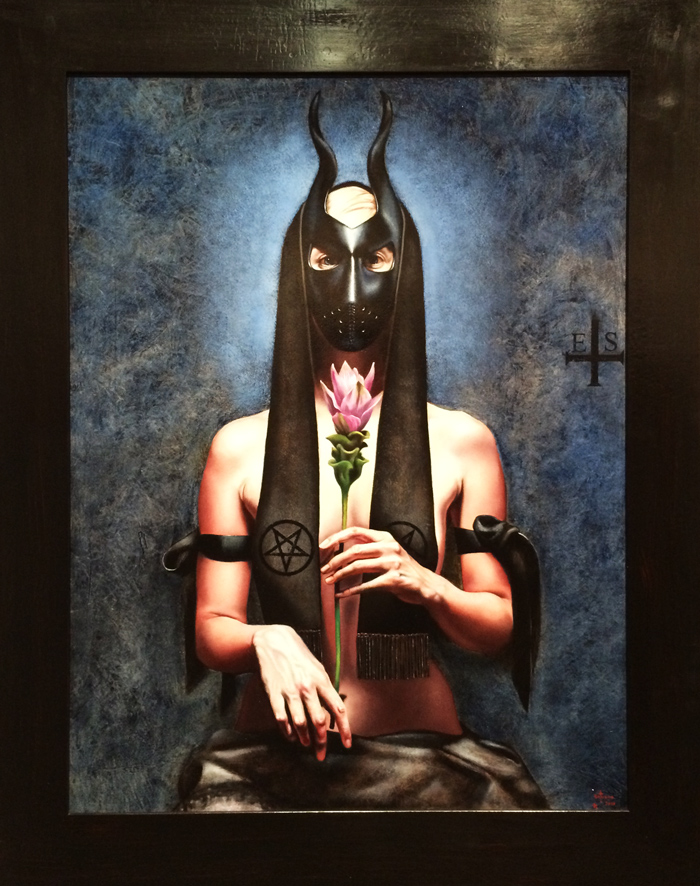
Photo by the PhotoPhore. Image courtesy of Saturno Buttò
– Saturno Buttò: “Eretico/Ieratico” – The “Heretic” theme
From the “hieratic” field, let’s move on to the concept of “heretic“.
The “heresy” of Saturno Buttò would be in the themes of his paintings.
In the Holy Art are portrayed scenes of all kinds, often violent, but the basic concept that it wants to express is the idea of Salvation, which resides in God.
In the works of Buttò, on the other hand, there are apparently opposed themes, such as “temptation“, “sin“, and the route on the “way of damnation“.
Thus, the Angels of the central painting of the exhibition, “Paradise Decadence – Three Angels“, are winged figures intent on committing “carnal sins“ rather than instructing the way of Salvation.
The Angel (not winged) who goes to visit the Virgin Mary in “The Angel and the Virgin“, seems to “lead into temptation“ the pious Virgin.
The character of the painting “Roberta ES“, with a demonic appearance, offers a flower, and seems to want to attract the viewer to herself, bringing him to perdition.
But it’s not to the “sin’s sake“ that Buttò’s interest is directed.
His “heresy“, if anything, is in having focused the attention on the charm of these figures, on their “eroticism” and on their “beauty“.
![Saturno Buttò, L'Angelo e la Vergine [The Angel and the Virgin], Oil on wood, 70x70 cm Photo by the PhotoPhore. Image courtesy of Saturno Buttò](https://www.thephotophore.com/wp-content/uploads/2018/10/saturno-butto-ieratico-eretico-007.jpg)
Photo by the PhotoPhore. Image courtesy of Saturno Buttò
– Saturno Buttò: “Eretico/Ieratico” – The Power of the “Beauty”
As the artist declared to Barbara Codogno in the exhibition’s statement, his main theme is just the “Beauty“.
«Because I paint Beauty and in beauty there is no violence or even sin. Never. My paintings convey love. Mine is just the joy of living. I love life, a life that obviously also contemplates the mutation, the evolution, the elevation of Man», he said.
In his painting, Buttò acts «giving voice to the profound contradictions of Man, to his impulses, to his eroticism, to his metamorphosis. Also sexual».
So here Saturno Buttò “comes back” from his alleged “heresy“.
Because, if it’s true that «the Beauty will save the world», according to Dostoevsky’s overquoted quotation, then also the paintings of Saturno Buttò make their splendid part for the profound Salvation of Man.
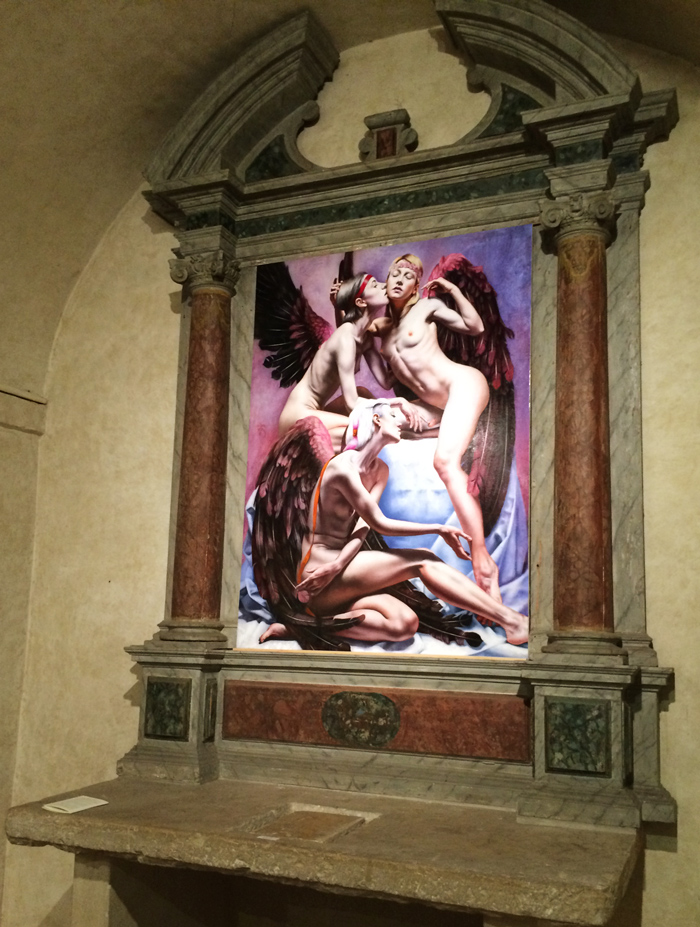
Photo by the PhotoPhore. Image courtesy of Saturno Buttò
“Eretico/Ieratico” by Saturno Buttò
06-21/10/2018
Oratorio di Santa Marua Assunta
via Rossignano
30038 Spinea (Venice)
For the ITALIAN reader, here you can find the ITALIAN TEXT!!
Text by Domenico Fallacara | the PhotoPhore
Discover: www.saturnobutto.com


