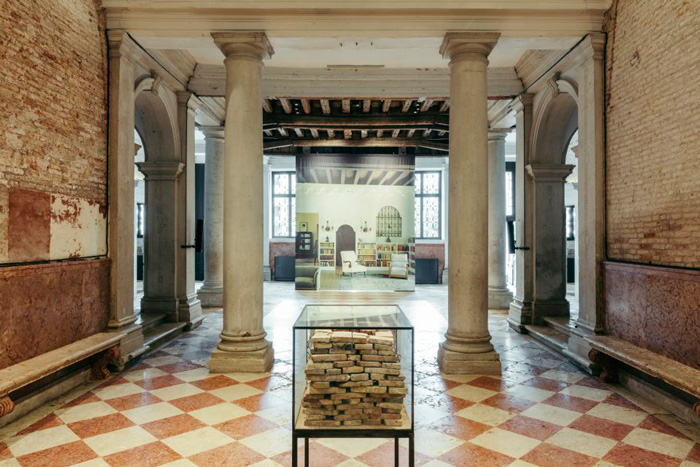
Not only the Biennale of Architecture in Venice these days. Many exhibitions, however, have a link with architecture, even if they go beyond.
This is the case of “Machines à penser“, the new exhibition of the Prada Foundation, held at its Venetian headquarters in Ca ‘Corner della Regina and which will last until 25 November 2018.
Curated by Dieter Roelstraete, the exhibition brings together under one roof [it is appropriate to say so] Art, Architecture and Philosophy.
The project deals with the relationship between three of the greatest philosophers of the twentieth century: Theodor W. Adorno, Martin Heidegger and Ludwig Wittgenstein and their homes.
It’s not about their apartments in the city, but about real hermitages: isolated places where the three philosophers decided to live a part of their life far from the world.
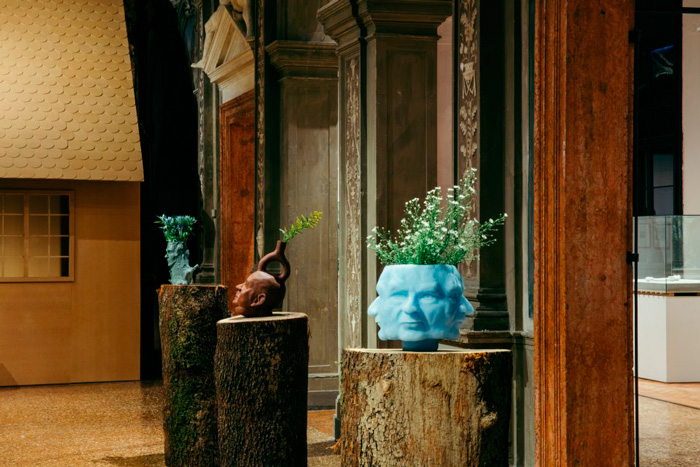
Prada Foundation – “Machines à penser”: The escape from society
The isolation, the “escape from society“, is a condition that has been lived by the three men, in different times and moments, and which has left important traces in their literary production.
Hidegger has lived for years in a cabin in Todtnauberg, Germany, in the heart of the Black Forest. Here he found the right peace to give the world one of his fundamental works: “Being and Time” (1927).
Wittgenstein built his refuge in Norway, in a difficult-to-access fjord. In this isolated place, his philosophical-scientific mind has elaborated the “Tractatus Logico-Philosophicus” (1921), a cornerstone of the philosophy of the twentieth century.
Adorno, instead, due to the takeover of Nazism in his native land, Germany, had even to cross the ocean, reaching even Los Angeles, where he could find the quiet to write one of his most famous and intimate books, the “Minima Moralia” (1951).
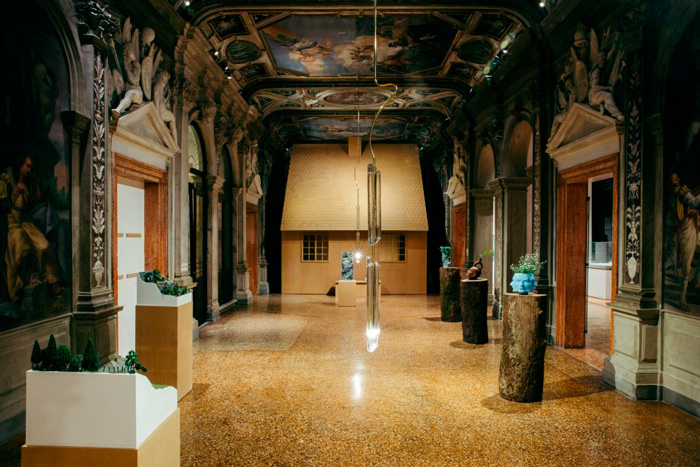
To retrace these events, in the spaces of Ca’ Corner della Regina, there are three main installations, around which the exhibition revolves.
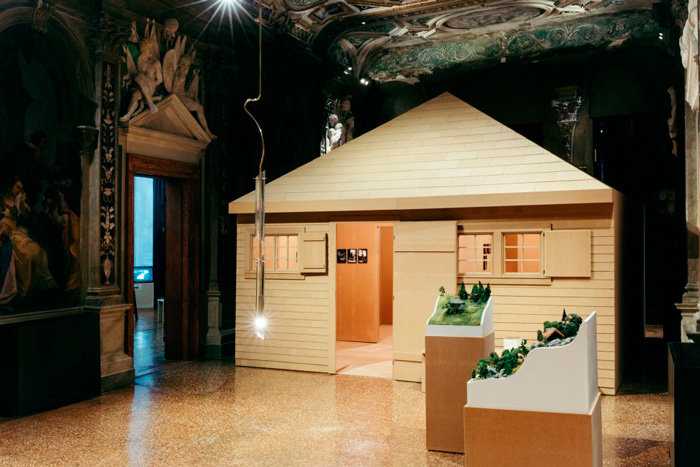
Prada Foundation – “Machines à penser”: The installations/houses of Hidegger and Wittgenstein
1. Hidegger’s dwelling in the Black Forest.
The hause was rebuilt in scale, to 88% of the original size, and it is actually possible to enter in it.
In the void of the unadorned installation/home, which contains only a few objects, a chair, a desk, as well as some photographs, it is possible to immerse concretely in the atmosphere that allowed the philosopher to compose his work.
2. Wittgenstein’s home in Norway.
The house can only be viewed from the windows, although the size of the reconstruction would allow us to enter it.
Inside, on the central fireplace, there is the only sculpture created by the philosopher: Head of a girl (1925-1928), together with some of his personal objects.
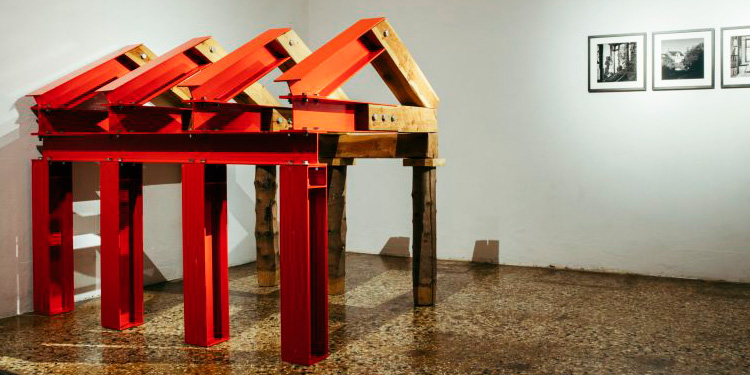
Prada Foundation – “Machines à penser”: The installation/house of Adorno
3. Adorno’s house is instead re-enacted by the sculpture of the Scottish artist and poet Ian Hamilton Finlay, who created, in 1987: Adorno’s Hut.
This installation re-interprets the myth of the “primeval hut“, beloved to architects and treatise writers such as the abbot Marc-Antoine Laugier. A vintage print of his famous Essai sur l’Architecture is also on display.
Laugier’s primeval hut, portrayed in the frontispiece of the essay, wants to go back to the real origins of the Architecture: only fronds and branches, arranged as columns and the warp of a sloping roof.
Laugier’s work asks: How was architecture born? And also: What, then, is architecture?
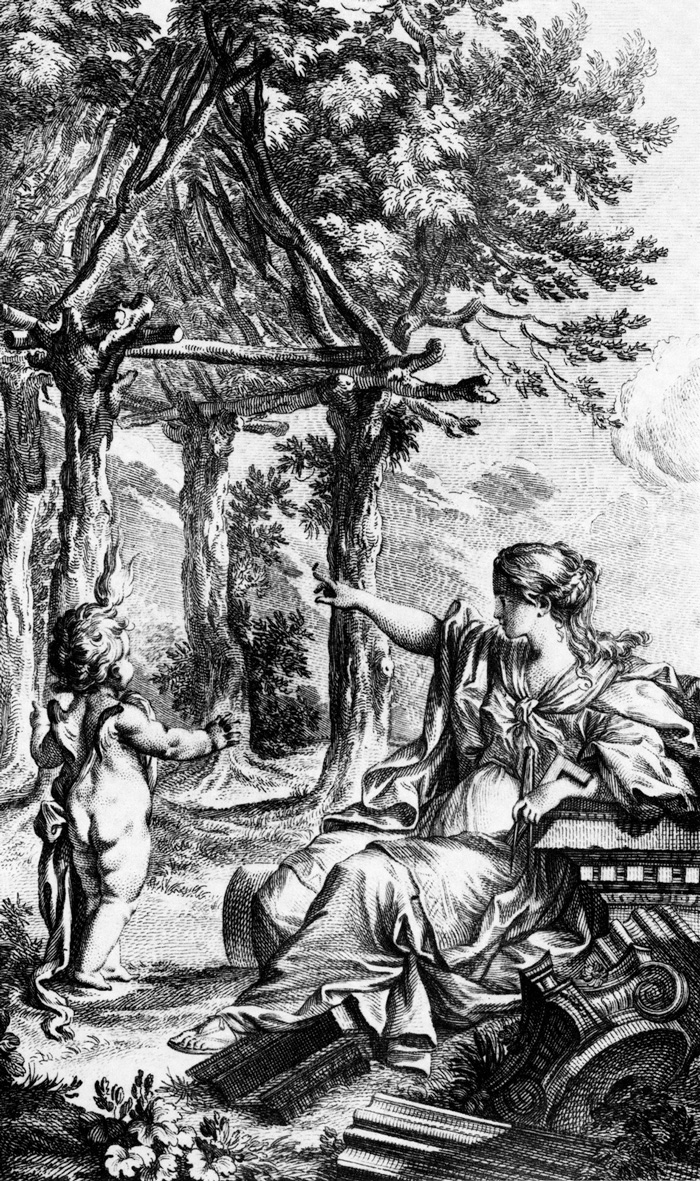
It is the science that allows the construction of houses, shelters, places for man, made by man. And in which the man should find the right conditions of life, the right detachment from the world, the right peace.
The installation, which recalls the idea of ”home“, is made up of half wood and half steel. In the act of introducing steel, one can perhaps read the idea that technological innovation can and must follow the primigenial concept, that is, the “simple” concept of a home for man.
Even though the technology and the materials vary, the “house“ must not change its “substantia“.
It should always be a refuge at the service of man. Because the relationship between “man” and his “home” is something profound, ancestral, natural. It can’t be a victim of the passage of time.
Man, in his intimate nature, has not changed too much, with the passing of the centuries. It is still an animal that needs a “den“, a place to withdraw from the world and to find himself.
Exactly how it was, though with obvious differences, for the three thinkers.
Prada Foundation – “Machines à penser”: The other artworks
Starting from the three main figures, Adorno, Hidegger and Wittgenstein, a series of works branch off to enrich the exhibition and to broaden the research.
The figure of Adorno, his forced removal from his home in Germany and the relationship between “space“ and “thought“, are explored through the works of artists such as Susan Philipsz, Ewan Telford, Patrick Lakey and Anselm Kiefer.
In Hidegger’s house, instead, there are photos of Digne Meller-Marcovicz, who portrayed the philosopher and his wife in Todtnauberg between 1966 and 1968.
There are the photographic prints of two works of art originally present in the house, and ceramic objects by Jan Bontjes van Beek.
The exhibited works of Giulio Paolini, Sophie Nys, Iñigo Manglano-Ovalle and Paolo Chiasera also derive from Hidegger’s thought.
The empty house of Wittgenstein highlights the feeling of “isolation“, of “peace“. Precisely from this human inspiration, the search for “inner peace“, starts the work, among others, of the Norwegian collective composed by Sebastian Makonnen Kjølaas, Marianne Bredesen and Siri Hjorth, by the artist Jeremy Millar and the photographer Guy Moreton.
Prada Foundation – “Machines à penser”: Saint Jerome
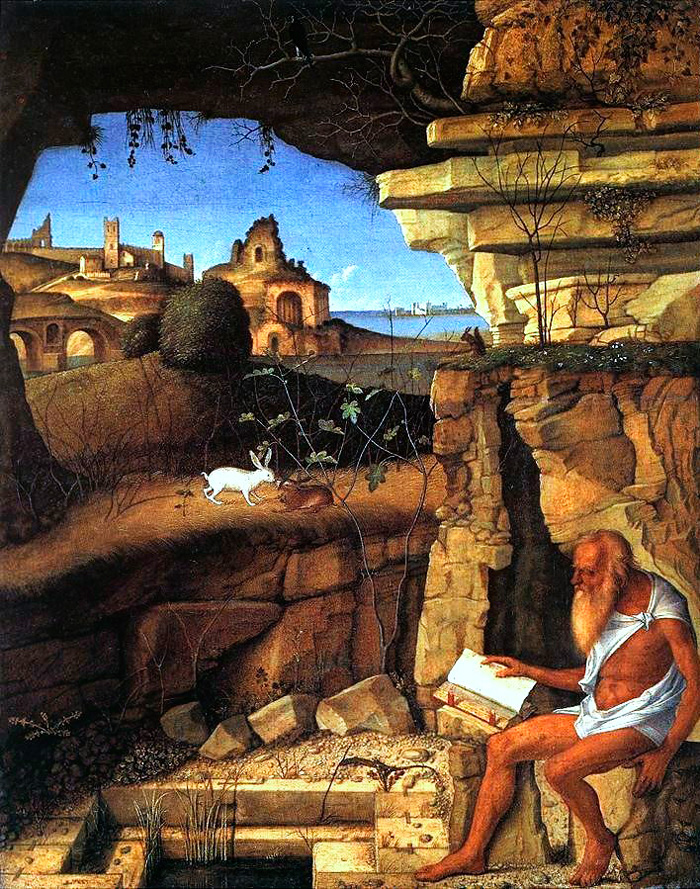
In addition to the 3 twentieth-century thinkers, there is another protagonist of the exhibition: Saint Jerome.
The saint, father and doctor of the Church, lived a part of his life as an anchorite, isolated from everyone.
Just in his isolation he would meet a wounded lion who, once healed, stood beside him in gratitude.
In “Machines à penser” there are displayed paintings and Renaissance prints that portray the saint and his lion, while alone live in peace.
Another man (and lion) with another different home, that better suits them.
“Machines à penser” is an exhibition about the “home“, but above all on the “man“. About how the relationship among “man“ and “home“ can direct his whole existence.
What we can see and perceive is how important is the link between the human being and the context in which he lives. How much the “place” can give him relief, can be comforting and inspirating, often more than the other human beings.
A “natural home“, made to the measure of the man who must live in it, is a primary requirement for the life of man.
If this “house-hut“, together with the isolation from other men, are the keys to produce great philosophy, is not said.
Although, certainly, they can help.
Machines à penser
26.05 – 25.11.2018
Prada Foundation
Ca’ Corner della Regina
Calle de Ca’ Corner,
Santa Croce 2215
30135 Venezia
Text by Domenico Fallacara | the PhotoPhore
Discover: www.fondazioneprada.org


